


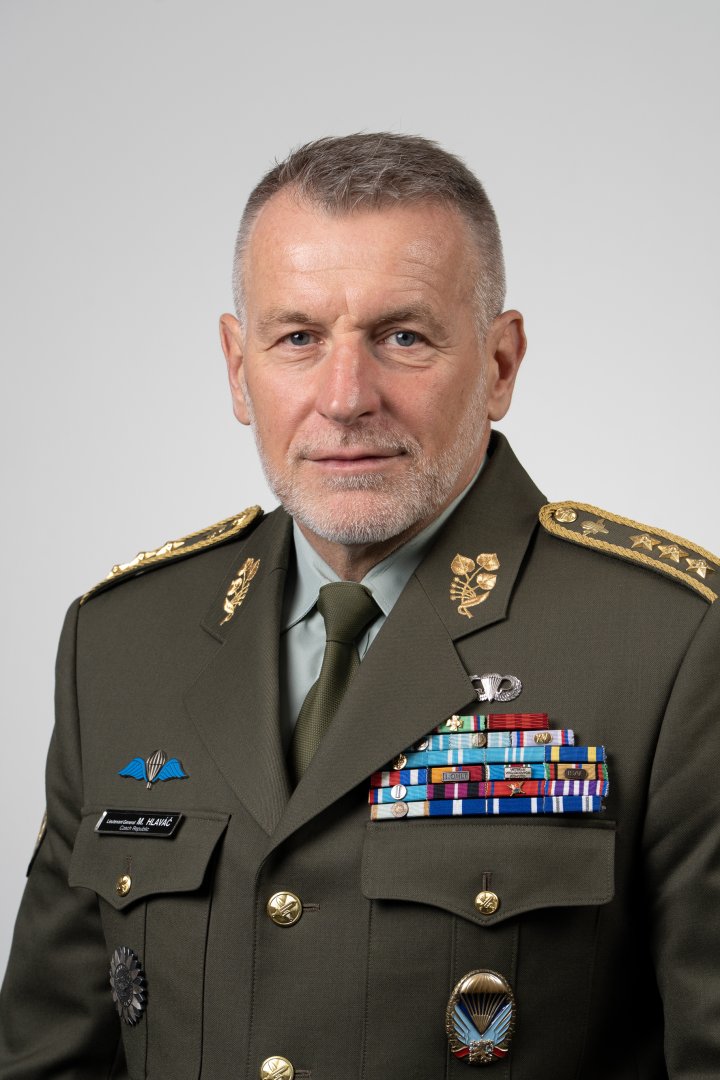
 Lieutenant General Miroslav Hlaváč
Distinguished Guests, Ladies and Gentlemen,
The pace of technological transformation is growing and so are the demands on our adaptability.
Artificial intelligence, autonomous systems, robotics, quantum technologies, and new ways to manage data have fundamentally changed our operational environment. The war in Ukraine has clearly showed us one thing: the battlefield transforms faster than the armed forces do.
New methods of using UAVs elicit new countermeasures, bringing along further changes. The technologies giving us an edge today may be outmatched few months from now. The ability to adapt is thus one of vital military capabilities.
It is not enough to merely react. We need to be able to quickly gain experience, analyse it, experiment, and integrate the lessons learned directly with the units. It is the fast learner who has the upper hand.
Adaptation is not a choice. It is a necessity. And the armed forces cannot do it alone.
We need a cooperative endeavour involving the armed forces, defence industry, research, academia and government institutions. We need to be able to share information and shorten the path from a good idea to an actual solution usable for the military.
I therefore regard deterrence and defence as something broader than a simple set of military capabilities. It includes an efficient defence industry, resilient economy, cyber security, information environment, and the ability to quickly replenish lost capabilities.
The introduction of new technologies and the digitalisation of the armed forces is one of my priorities. But mere technology does not suffice. We have to know what we need it for, how we are going to use it, and what advantage it gives us on the battlefield.
That is why I do not want us to just wait for readymade solutions. We need to experiment, test and prove new technologies in conditions as close to real operational employment as possible. It is the only way to find out what actually works.
The Czech Armed Forces is currently undergoing a fundamental modernisation. But it is not only about acquiring new equipment. Modernisation only makes sense if we also change the way we fight, command, gather information, and make decisions.
Equipment is the means. The ability to meet the mission is the goal.
Future conflicts will favour the militaries that can learn quickly, make decisions at speed and adapt faster than their opponents.
The Future Forces Forum connects those who can contribute to that objective – military professionals, subject-matter experts, researchers, plus industry representatives and government officials. It offers a platform for exchanging experience and indeed for identifying solutions we can apply in practical applications.
And that is exactly what we need today.
Lieutenant General Miroslav HLAVÁČ
Chief of the General Staff of the Czech Armed Forces